Jacob is one of the most complex and human figures in the Bible. His story stretches from Genesis 25 to Genesis 50, and his life reads less like a straight line of virtue and more like a long, winding journey of transformation. Jacob is a man of promises, yet plagued by fear; chosen by God, yet shaped through struggle. His life shows us how God works not only with the righteous, but with the restless, the flawed, and the becoming.
Jacob is the third patriarch of Israel, following Abraham and Isaac. His story is not merely biographical—it is theological. In Jacob, we see the birth of a nation, the shaping of Israel’s identity, and the mystery of divine grace operating through imperfect vessels.
1. Jacob’s Birth and the Struggle for Primacy (Genesis 25:19–34)
Jacob’s story begins even before his birth. Rebekah conceives twins, and they struggle within her womb. God reveals to her:
“Two nations are in your womb… and the older shall serve the younger.” (Genesis 25:23)
This prophecy frames Jacob’s entire life. He is born second, grasping the heel of his brother Esau. His name, Jacob (Ya‘aqov), is linked to ideas of heel-grabber, supplanter, or one who follows closely.
As they grow:
Esau becomes a hunter, a man of the field
Jacob becomes a quiet man, dwelling in tents
Jacob’s first defining act is purchasing Esau’s birthright for a bowl of stew. Though Esau despises his birthright, Jacob’s method reveals ambition mixed with opportunism. Already, the tension between divine promise and human manipulation emerges.
2. The Stolen Blessing and a Broken Family (Genesis 27)
The turning point of Jacob’s early life is the deception of his father Isaac. With Rebekah’s guidance, Jacob disguises himself as Esau and receives the patriarchal blessing.
This act secures what God had promised—but through deceit. The consequences are severe:
Esau vows to kill Jacob
Jacob becomes a fugitive
The family is fractured
Here, Jacob gains the blessing, but loses his home. The blessing carries promise, but also pain.
3. Bethel: Encounter with the God of Promise (Genesis 28:10–22)
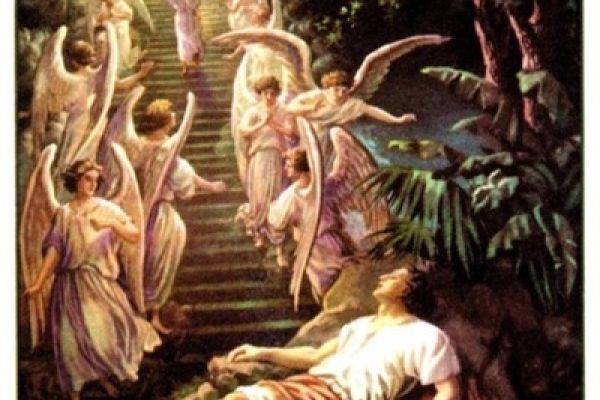
Fleeing to Haran, Jacob stops for the night and dreams of a ladder (or stairway) reaching from earth to heaven, with angels ascending and descending. God speaks, reaffirming the Abrahamic covenant:
Land
Descendants
Blessing to all nations
Jacob awakens in awe:
“Surely the LORD is in this place, and I knew it not.” (Genesis 28:16)
He names the place Bethel (“House of God”) and makes a vow. This is Jacob’s first personal encounter with God—not through inheritance, but through revelation. Still, his faith is conditional, cautious, and transactional.
4. Jacob the Laborer: Love, Laban, and Long Refinement (Genesis 29–31)
Jacob arrives in Haran and meets Rachel, whom he loves deeply. He agrees to work seven years for her, but is deceived by Laban and married to Leah instead. He works another seven years for Rachel.
This season is crucial:
The deceiver is deceived
The manipulator is manipulated
The heel-grabber learns endurance
Jacob fathers twelve sons and one daughter, through Leah, Rachel, Bilhah, and Zilpah. These sons become the twelve tribes of Israel.
God prospers Jacob despite Laban’s schemes, teaching him that blessing flows from divine favor, not cleverness.
5. Wrestling with God: From Jacob to Israel (Genesis 32)
On his return to Canaan, Jacob must face Esau. Fear overwhelms him. The night before their meeting, Jacob is left alone—and wrestles with a mysterious man until dawn.
This encounter is the climax of Jacob’s transformation:
His hip is dislocated
He refuses to let go without a blessing
His name is changed
“Your name shall no longer be called Jacob, but Israel, for you have struggled with God and with men, and have prevailed.” (Genesis 32:28)
Jacob limps away—but blessed. Strength now comes through weakness. Identity is no longer seized; it is received.
6. Reconciliation with Esau (Genesis 33)
Jacob meets Esau, expecting violence. Instead, Esau runs to embrace him. Years of fear dissolve in forgiveness.
This moment reveals that God has been working on both brothers. Jacob bows seven times, no longer grasping, but yielding. The blessing no longer needs to be defended.
7. Tragedy, Discipline, and Return to Bethel (Genesis 34–35)
Jacob’s family faces moral and spiritual crisis—particularly in the incident involving Dinah and the violent retaliation of Simeon and Levi.
God calls Jacob back to Bethel, where:
Idols are buried
Jacob builds an altar
God reaffirms his name as Israel
Rachel dies giving birth to Benjamin, and Isaac later dies as well. Jacob continues forward, now carrying both promise and loss.
8. Jacob and Joseph: From Favoritism to Redemption (Genesis 37–50)
In his later years, Jacob favors Joseph, Rachel’s firstborn. This favoritism leads to jealousy, betrayal, and Joseph’s apparent death.
Years later, during famine, Jacob discovers Joseph is alive and ruler in Egypt. Their reunion is one of Scripture’s most moving moments.
Jacob’s final years are marked by blessing his sons—prophetic words that shape Israel’s future—and by peace rooted in God’s faithfulness.
9. Jacob’s Death and Legacy (Genesis 49–50)
Jacob dies in Egypt but is buried in Canaan, alongside Abraham and Isaac. His life closes not as the schemer he began as, but as Israel, the father of a nation.
His legacy includes:
The twelve tribes
A theology of transformation
A witness that God redeems character through process
Theological Themes in Jacob’s Story
1. Grace Over Merit
God’s choice of Jacob reveals divine election rooted in grace, not moral perfection.
2. Transformation Through Struggle
Jacob is shaped not by comfort, but by conflict—with family, with systems, and with God.
3. Identity as a Journey
Jacob’s name change shows that identity unfolds over time, not in a moment.
4. God’s Faithfulness to Promise
Despite Jacob’s failures, God remains faithful to His covenant.
Jacob’s Story as Our Story
Jacob’s life mirrors the human condition: striving, fearing, grasping, and eventually surrendering. His story assures us that God does not abandon us mid-process. He meets us on roads of exile, wrestles with us in the night, and renames us at dawn.
Jacob begins as a heel-grabber—but ends as Israel, a prince who learned to walk with a limp, leaning not on his own strength, but on God’s enduring promise.