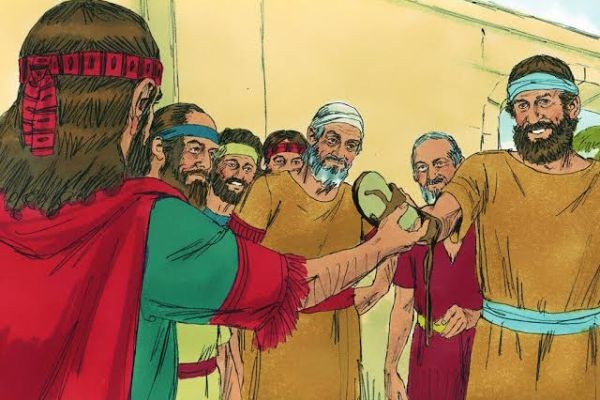
Yes. Ruth 4:3–10 can be understood as a beautiful picture pointing toward Christ and His redeemed people, although Ruth itself is not explicitly saying that Boaz is Jesus. The connection is a biblical typological pattern: Boaz acts as a kinsman-redeemer, and Christ is the ultimate Redeemer.
1. The property — what was lost
Naomi's family had lost its inheritance because of the circumstances surrounding Elimelech's death and the family's time in Moab.
The land had to be redeemed.
This gives us a picture of something belonging to God's people that has been lost and needs restoration.
In the larger biblical story, humanity also lost its inheritance through sin.
“For all have sinned, and come short of the glory of God.” — Romans 3:23
2. The advertisement — the invitation
Boaz says:
“I thought to advertise thee, saying, Buy it before the inhabitants, and before the elders of my people.” — Ruth 4:4
The opportunity is publicly presented.
This can point us toward the proclamation of the Gospel.
The Gospel announces that redemption is available through Christ:
“For God so loved the world, that he gave his only begotten Son…” — John 3:16
The Gospel is, in a sense, heaven's announcement:
Redemption is available. Come to the Redeemer.
3. The purchase — a price is involved
The nearer kinsman says:
“I will redeem it.” — Ruth 4:4
But biblical redemption is not merely an announcement. A price has to be paid.
That is where the picture becomes much deeper in Christ.
Peter says:
“Ye were not redeemed with corruptible things, as silver and gold… But with the precious blood of Christ.” — 1 Peter 1:18–19
Boaz redeemed through a legal transaction.
Christ redeemed through His blood.
4. The nearer redeemer could not complete the redemption
This is one of the most powerful parts of Ruth 4.
The nearer kinsman initially says he will redeem the land. But when Ruth becomes part of the matter, he says:
“I cannot redeem it for myself.” — Ruth 4:6
He could not fulfill the complete redemption.
This points beautifully toward the limitation of the law and human ability.
Humanity needed another Redeemer.
And Boaz was qualified.
5. Boaz was the qualified redeemer
Boaz was:
a kinsman
willing to redeem
able to redeem
able to pay the price
willing to take Ruth as his own
Christ fulfills the ultimate reality behind this pattern.
He became our Kinsman by taking humanity upon Himself:
“Forasmuch then as the children are partakers of flesh and blood, he also himself likewise took part of the same…” — Hebrews 2:14
He was willing.
He was able.
He paid the price.
And He took the redeemed as His own.
6. Ruth — the redeemed
This is where the picture becomes particularly beautiful.
Ruth was a Moabite widow, an outsider to Israel.
Yet she is brought into the covenant family through the redemption of Boaz.
And eventually Ruth becomes part of the lineage of David:
Ruth → Obed → Jesse → David → Christ.
So the woman who was once an outsider becomes part of the messianic lineage.
That points toward the mystery of the Church: people who were once “aliens from the commonwealth of Israel” are brought near through Christ.
“But now in Christ Jesus ye who sometimes were far off are made nigh by the blood of Christ.” — Ephesians 2:13
7. The redeemed become the bride
There is an even greater fulfillment.
Boaz doesn't merely purchase the field.
He takes Ruth.
“Moreover Ruth the Moabitess, the wife of Mahlon, have I purchased to be my wife…” — Ruth 4:10
That is remarkable typologically.
Christ doesn't merely rescue people from destruction.
He redeems a people for Himself.
The New Testament describes the Church as the bride of Christ:
“Christ also loved the church, and gave himself for it.” — Ephesians 5:25
So Ruth's story moves from:
outsider → redeemed → received → married → incorporated into the lineage
And the Gospel moves from:
sinner → redeemed → justified → adopted → united with Christ → part of His Bride.
The complete picture
You could therefore express Ruth 4's pattern this way:
ADVERTISE
The opportunity of redemption is proclaimed.
↓
BUY
The Redeemer accepts the transaction.
↓
PAY THE PRICE
The redemption is accomplished at a cost.
↓
REDEEM
The property and the person are restored.
↓
RECEIVE
Ruth becomes Boaz's wife.
↓
INHERITANCE
The redeemed become part of the covenant lineage.
And in Christ:
THE GOSPEL IS ANNOUNCED
↓
CHRIST PURCHASES
↓
CHRIST PAYS THE PRICE WITH HIS BLOOD
↓
CHRIST REDEEMS
↓
THE REDEEMED BECOME HIS
↓
THE REDEEMED BECOME HIS BRIDE
↓
THE REDEEMED RECEIVE AN INHERITANCE
This makes Ruth 4 a remarkably rich picture of the Redeemer and the redeemed.
And there is one especially profound connection: Boaz's redemption of Ruth ultimately leads into the genealogy of Jesus Christ in Matthew 1. Ruth, the outsider who was redeemed, becomes part of the very family line through which the Redeemer Himself enters the world.
So, in a beautiful biblical sense:
The story of the redeemer in Ruth eventually becomes part of the story of the Redeemer in Christ.