By Olashoplife
It is not oil.
It is not real estate.
It is not banking.
It is data.
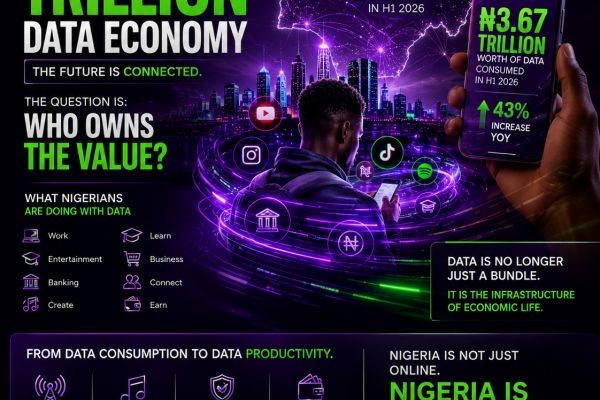
According to recent figures reported by BusinessDay, Nigerians consumed an estimated ₦3.67 trillion worth of internet data in the first half of 2026. That represents a 43 percent increase from the estimated ₦2.57 trillion consumed in the same period of 2025. Nigerians consumed approximately 8.52 million terabytes of data between January and June alone.
And here is the provocative question:
If Nigerians are spending trillions to participate in the digital economy, why are most Nigerians still merely consumers of that economy?
We Are Paying to Enter the Digital Economy
Think about what happens every morning.
You buy data.
You open WhatsApp.
You watch YouTube.
You stream music.
You scroll Instagram.
You search Google.
You post on TikTok.
You transfer money.
You advertise your business.
You attend an online meeting.
You read an article.
You watch a movie.
You learn something.
You sell something.
You create something.
And almost every one of these activities requires data.
Data has quietly become the entrance ticket to modern economic life.
The Nigerian Communications Commission's figures show broadband subscriptions rising from 115.04 million in January to 123.11 million in June 2026, while total telecom subscriptions rose to 192.23 million.
Connectivity is no longer simply about making phone calls.
Connectivity is becoming economic infrastructure.
But There Is a Problem
Nigeria is becoming very good at consuming the digital economy.
The bigger question is whether we are becoming equally good at owning it.
Imagine this:
A Nigerian spends ₦20,000 on internet data.
That data is then used to watch foreign entertainment, interact with foreign platforms, use foreign software, advertise on foreign social networks and purchase foreign digital products.
The Nigerian has spent money.
The telecom operator has generated revenue.
The platform has generated revenue.
The advertiser has generated revenue.
The technology company has generated revenue.
But what did the Nigerian actually own at the end?
This is the uncomfortable conversation we need to have.
Data Is Not the Economy. It Is the Highway.
We should be careful about one thing.
The estimated ₦3.67 trillion is not the same thing as ₦3.67 trillion of telecom-company revenue. BusinessDay's calculation uses an average benchmark of ₦431 per gigabyte to assign an economic value to the volume of data consumed.
But the bigger idea remains powerful.
Data is the highway.
And increasingly, everything is travelling on it.
Money travels on it.
Music travels on it.
Ideas travel on it.
Businesses travel on it.
Education travels on it.
Entertainment travels on it.
Influence travels on it.
Even identity increasingly travels on it.
So the real economic question isn't simply:
How much data are Nigerians consuming?
The better question is:
What are Nigerians building with the data they consume?
The Next Nigerian Billionaires May Not Sell Data
The telecommunications companies are obviously positioned to benefit.
MTN Nigeria, for example, reported ₦1.699 trillion in data revenue in H1 2026, up 38.4 percent year-on-year.
But telecom companies are only the first layer.
The much bigger opportunity is everything built on top of the network.
That means:
Creator platforms.
Digital banks.
Marketplaces.
Streaming platforms.
AI companies.
Digital publishing.
Gaming.
Online education.
Digital advertising.
Fintech.
Digital assets.
Royalty systems.
Social commerce.
The infrastructure companies provide the road.
Entrepreneurs build businesses on the road.
Creators generate culture on the road.
Consumers create attention on the road.
And attention can become money.
The Creator Is Becoming an Economic Institution
This is where things become particularly interesting for Olashoplife.
The Nigerian musician is no longer merely a musician.
The writer is no longer merely a writer.
The fashion designer is no longer merely a fashion designer.
The YouTuber is no longer merely a YouTuber.
The creator is becoming a digital economic institution.
A song can attract millions of streams.
A video can attract millions of views.
A writer can build thousands of readers.
A designer can build a global audience.
But the question is:
Can the economic value created by that attention be captured, measured, exchanged and shared?
That is where the next revolution begins.
What If Content Could Behave Like Money?
This is the question we should be asking.
What if a song were not merely something you listen to?
What if it could represent an economic relationship?
What if royalties could become programmable?
What if fans could participate more directly in creator economies?
What if digital content could become part of commerce rather than simply advertising for commerce?
What if the things Nigerians create online could become assets within digital financial ecosystems?
This is the thinking behind the emerging intersection of music, publishing, fintech, digital commerce and digital assets.
The future may not separate content from finance as sharply as we do today.
A song can generate royalties.
A book can generate sales.
A creator can generate subscriptions.
An audience can generate transactions.
A community can generate economic activity.
Why shouldn't the infrastructure connecting these activities participate in the value?
From Data Consumption to Data Productivity
Nigeria does not necessarily need to consume less data.
Nigeria needs to become more productive with data.
There is a difference.
Consumption says:
"I used 10GB today."
Productivity asks:
"What did that 10GB help me create?"
Did it help you sell ₦100,000 worth of products?
Did it help you release a song?
Did it help you acquire customers?
Did it help you learn a skill?
Did it help you build software?
Did it help you earn foreign exchange?
Did it help you create intellectual property?
Did it help you build an audience?
Did it help you create an asset?
That is the difference between a digital consumer and a digital economic participant.
Nigeria's Digital Gold Rush Has Already Started
The interesting thing is that nobody had to announce it.
There was no presidential declaration.
There was no national ceremony.
There was no "Digital Economy Day."
People simply started connecting.
And then they started creating.
Then they started selling.
Then they started streaming.
Then they started transferring money.
Then businesses started moving online.
Then artificial intelligence arrived.
Now the volume is becoming impossible to ignore.
Nigeria's data consumption jumped 43 percent year-on-year in H1 2026.
That is not just a telecommunications statistic.
It is a cultural and economic signal.
Nigeria is moving from a physical-first economy toward a hybrid economy where physical and digital value increasingly overlap.
The Next Question Is Ownership
This is perhaps the most important conversation for Nigerian entrepreneurs.
We have spent years asking:
How do we get more Nigerians online?
That question was necessary.
Now we need a new question:
How do we help Nigerians own more of what they create online?
Because access without ownership can create dependency.
A country can have millions of internet users and still capture relatively little value from the global digital economy.
The objective should therefore be bigger than connectivity.
It should be digital ownership.
Ownership of platforms.
Ownership of intellectual property.
Ownership of audiences.
Ownership of businesses.
Ownership of data infrastructure.
Ownership of financial relationships.
Ownership of creative assets.
The ₦3.67 Trillion Question
So perhaps we should stop looking at ₦3.67 trillion as merely the amount Nigerians spent on internet data.
Look at it differently.
It represents the scale of the attention, transactions, communication, entertainment, learning, commerce and creativity flowing through Nigeria's digital infrastructure.
The money being spent on data is only the beginning.
The real economy is what happens after Nigerians connect.
That is where Olashoplife sees the opportunity.
Not simply to help Nigerians consume the internet.
But to help transform creativity into economic value.
Music into commerce.
Content into assets.
Attention into opportunity.
Royalties into financial relationships.
And connectivity into wealth.
Because the future of the Nigerian digital economy cannot simply be:
Buy data. Consume content. Repeat.
The bigger future is:
Connect. Create. Own. Exchange. Earn.
Nigeria has already built a massive appetite for data.
Now it is time to build an economy that makes that appetite productive.
The data economy is already here.
The real question is no longer whether Nigerians will participate.
The question is: who will own the value?
— Olashoplife
Communicating Joyful Wealth.
Visiti https://olashoplife.com